

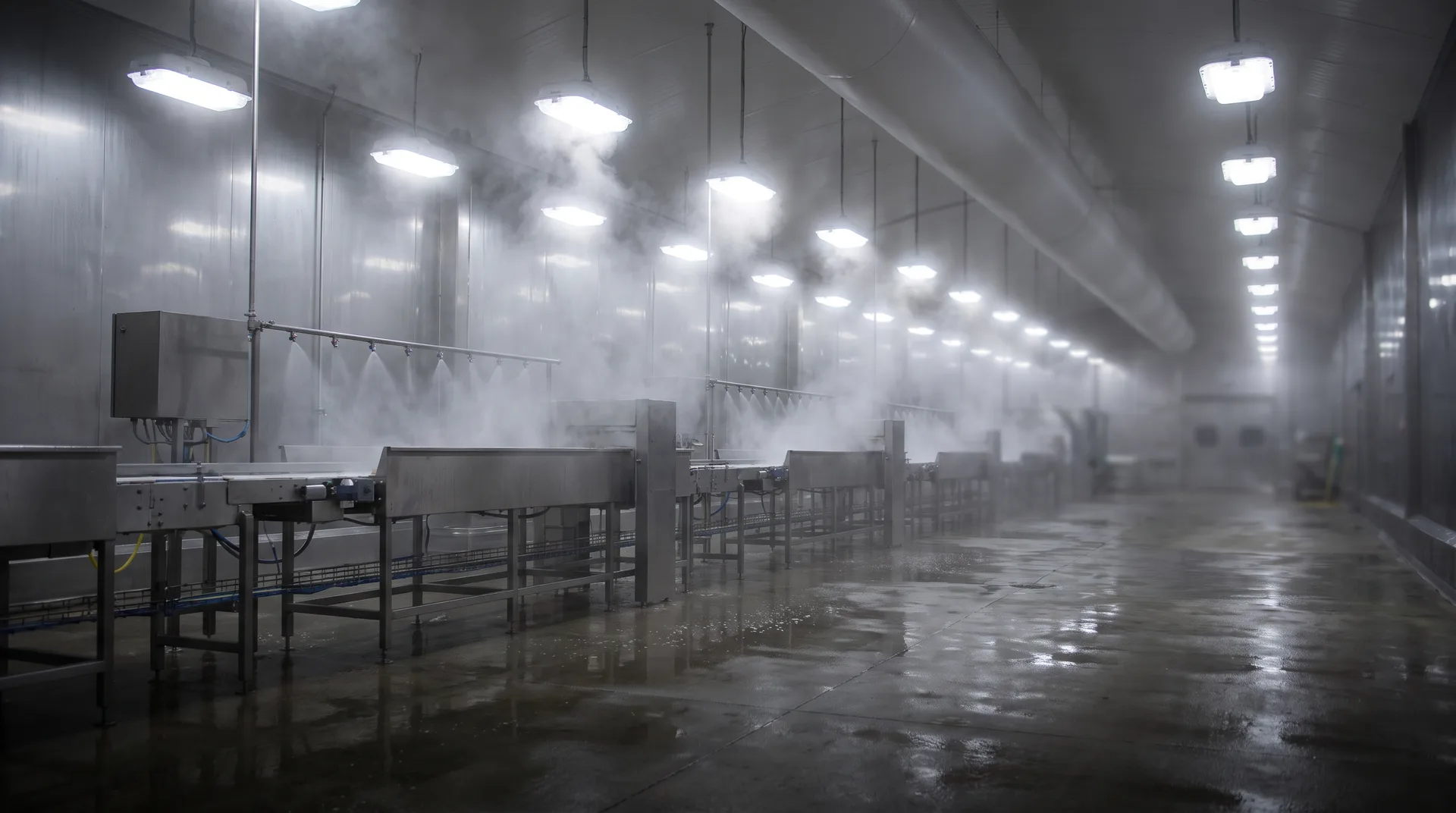
Our Food Processing & Washdown Lighting guide covers the regulatory side: how CFIA, MAPAQ, RBQ, and ESA classify a food plant's zones and what code compliance looks like in Quebec and Ontario. US plants generally follow USDA/FSIS sanitary design guidance rather than CFIA/MAPAQ, but the fixture-selection principles below apply under either framework. This page is the fixture-selection follow-on: once you know a zone needs wash-down lighting, here's how to actually pick between fixtures, beyond the IP rating printed on the box.
Start with the IP rating, but don't stop there
IP69K (see our IP69K vs IP67 explainer for the exact test parameters) tells you a fixture survives high-pressure, high-temperature spray. It doesn't tell you about housing material, lens durability, mounting access, or how the fixture behaves over a five-year sanitation cycle. Those are separate decisions.
Housing material: stainless, FRP, or coated aluminum
| Material | Strengths | Trade-offs |
|---|---|---|
| Stainless steel | Most impact-resistant, easiest to sanitize, standard for direct food-contact zones | Heaviest, highest cost |
| FRP (fiberglass-reinforced polyester) | Lighter, won't corrode, easier overhead mounting | Less impact-resistant than stainless |
| Coated die-cast aluminum | Lower cost, good for splash/perimeter zones | Coating can chip under repeated caustic exposure; verify the coating spec before use in direct wash-down |
Operators commonly mix materials by zone: stainless near impact and direct-contact areas, FRP overhead where impact risk is low.
Lens material
The lens should be polycarbonate or impact-resistant tempered glass, never standard glass. A cracked or chipped standard-glass lens is a physical-contamination risk in a food plant, and most food-safety programs treat it as an automatic recall trigger for the affected batch. Polycarbonate also resists the thermal shock of alternating hot wash cycles and cold storage better than glass.
Fixture form factor: match the zone, not the catalog page
- Round sealed high bay (like our SWD Series): suited to higher-ceiling production halls where a wide, even spread matters more than color-critical inspection work.
- Linear (like our HB12 Series): suited to lower-clearance lines, cold rooms, and inspection tables, where a narrower light band over a conveyor or bench is more useful, and where CRI 90+ optics support visual grading.
Don't default to whichever fixture is easiest to source. Mounting height and task (general illumination vs. inspection) should drive the choice.
Light level and color rendering by task
The light levels below are typical targets, not a regulatory minimum. Confirm the actual requirement against your facility auditor's checklist and IES recommended practice for the specific task.
| Task | Target light level | CRI |
|---|---|---|
| General production floor | ~500 lux | 80+ |
| Sorting / inspection lines | ~750 lux | 80–90+ |
| Quality-control benches, color grading | 1,000+ lux | 90+ |
If your line does any visual inspection for spoilage, discoloration, or foreign material, spec CRI 90+. It's the difference between catching a defect and missing it under a lower-CRI fixture.
Connectors and cable entries: the detail that fails first
A sealed fixture with an unsealed gland or connector doesn't stay sealed. Match every cable entry, gland, and quick-connector to the same wash-down rating as the fixture body. Waterproof male/female quick-connectors between driver and lamp body (standard on fixtures like the HB12) simplify maintenance without breaking the seal. A technician can swap a failed component without opening the sealed housing itself.
Mounting and maintenance access
Plan mounting height and orientation so sanitation crews can clean the fixture as part of the normal wash-down pass, without needing a ladder or disassembly. A fixture that's technically IP69K-rated but mounted somewhere the cleaning crew can't reach effectively will still accumulate residue and biofilm around unreached surfaces.
Cold-storage and temperature swings
Zones that cycle between a hot wash (up to 80°C water) and cold storage (down to −30°C) put more thermal stress on seals and lenses than either extreme alone. If your zone does both, confirm the fixture's rated operating range covers the full swing, not just the wash temperature.
Putting it together
A wash-down fixture spec has five layers: IP rating (IP69K for direct wash-down/CIP), housing material (stainless/FRP for direct-contact, coated aluminum acceptable elsewhere), lens material (polycarbonate, never standard glass), light level and CRI matched to the task, and connectors/mounting that preserve the seal in practice, not just on paper. Print our washdown compliance checklist to walk through all five before you finalize a spec, and browse our Food Processing IP69K line or industrial food-processing category for fixtures built to this spec.
Common questions
Do I need the same spec everywhere in the plant? No. Direct-contact and CIP zones need the full IP69K/stainless/polycarbonate spec. Dry storage and office areas typically only need IP65/IP66 industrial fixtures. Zoning correctly avoids paying a 2–3x premium to over-spec low-risk areas.
What's the biggest mistake in a washdown lighting spec? Matching the fixture body's IP rating but not the cable glands and connectors. An unsealed or mismatched gland is the single most common point of water ingress on an otherwise-correct wash-down fixture.
Can I use the same fixture in a dust-hazard zone, like a flour handling area? Not automatically. IP69K is a wash-down and sealing rating; it says nothing about combustible-dust ignition risk. Dry-ingredient handling (flour, sugar, milk powder) needs a separately Class II dust-rated fixture; see our Grain Handling guide for that hazard class.
What CCT is best for inspection lighting? 4000-5000K (neutral to cool white) is the typical target for inspection and sorting tasks. That range renders color and surface detail more accurately for visual grading than warmer CCTs, which is why it's the common default on quality-control lines. Confirm against your specific inspection protocol if one is specified.
Does IP69K alone make a fixture food-safe? No. IP69K only certifies ingress protection against pressure and heat. Food-safe status also depends on materials and construction, such as NSF or 3-A listing, smooth non-shedding surfaces, and food-grade gaskets. Check for those certifications separately rather than assuming an IP69K rating covers them.
How often should wash-down fixtures be inspected? Tie fixture inspection to your existing sanitation audit cycle: check lens integrity, gasket condition, and connector seals whenever the zone gets its scheduled deep clean, rather than running a separate maintenance calendar.
Sources: IEC 60529, ISO 20653, NSF/ANSI 2, CFIA Food Safety regulations. See also our Food Processing & Washdown Lighting guide for the regulatory classification side.
Need a fixture spec'd to your environment? Send the room dimensions, classification, and ambient, we'll come back same day.
Request Quote