
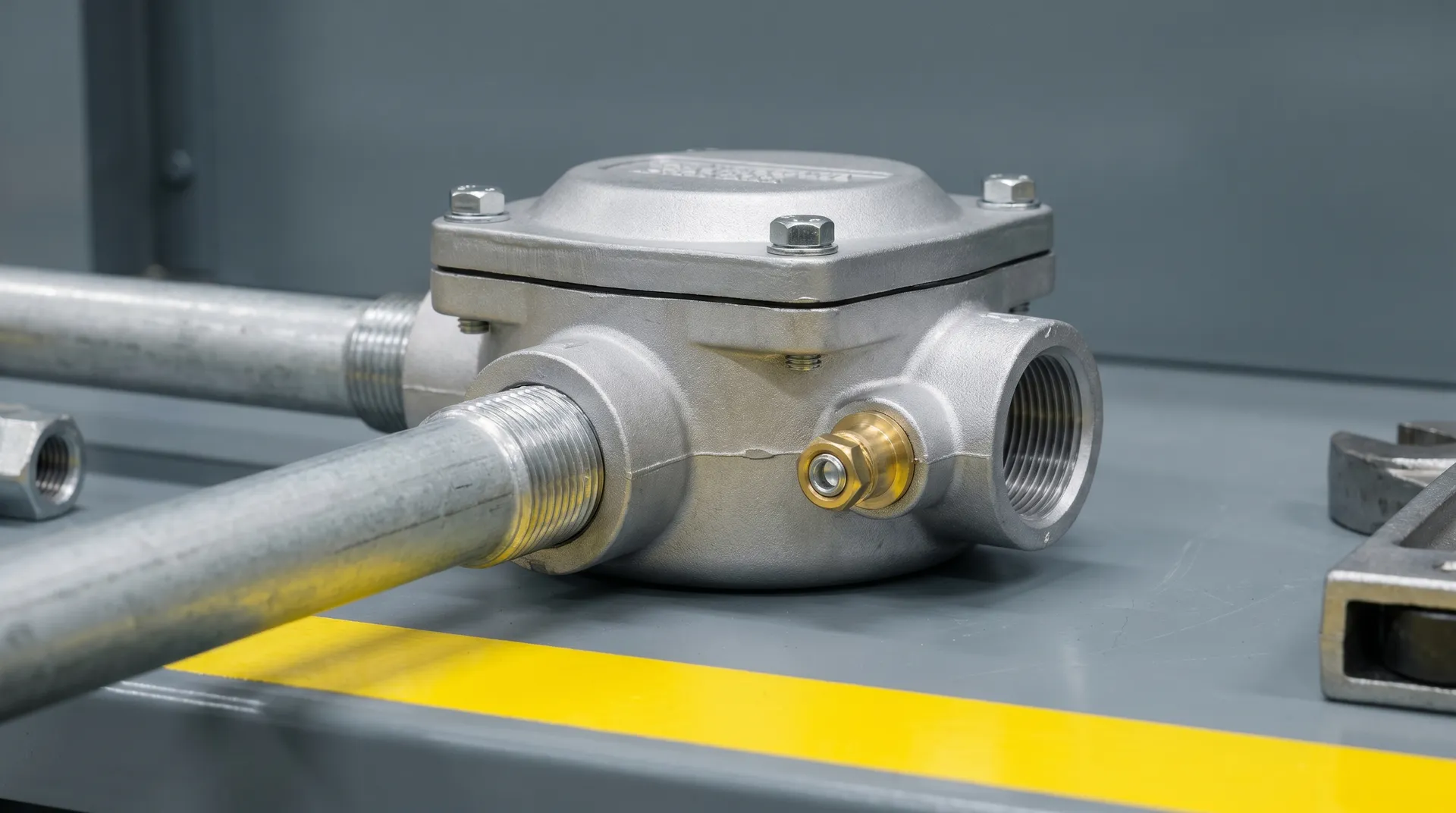
If you're spec'ing a hazardous-area fixture, four labels on the nameplate decide whether it's the right one or whether your install fails inspection. Class. Division. Group. T-code. Here's what each one actually means in plain terms, no NEC quoting, no Latin.
Class: what kind of hazard
The Class tells you the type of flammable material that could be in the air.
| Class | What's in the air | Examples |
|---|---|---|
| Class I | Flammable gases or vapors | Natural gas, propane, gasoline, ether, hydrogen, paint solvents |
| Class II | Combustible dust | Grain, flour, sugar, coal dust, metal dust, plastic resin |
| Class III | Easily ignitable fibers / flyings | Cotton fiber, sawdust, sisal, rare in modern plants |
Most hazloc lighting is Class I or Class II. Class III is uncommon and usually uses standard industrial fixtures with good housekeeping practice.
Division: how often the hazard is present
The Division tells you whether the hazard is normally present or only present when something goes wrong.
| Division | When the hazard exists | Fixture protection method |
|---|---|---|
| Division 1 | Continuously, frequently, or during normal operation | Containment: explosion-proof housing that holds the ignition inside |
| Division 2 | Only under abnormal conditions (leak, equipment failure) | Prevention: sealed housing that can't ignite the atmosphere |
Division 1 fixtures are heavier, costlier, and always work in Division 2 areas. Division 2 fixtures are lighter, cheaper, but can never be used in Division 1.
Group: what the specific gas or dust is
Once you know the Class, the Group tells you the specific chemical hazard. Gas Groups (Class I) and dust Groups (Class II) are separate.
Class I gas Groups:
| Group | Examples | Fixture marker |
|---|---|---|
| A | Acetylene | Group A only |
| B | Hydrogen, ethylene oxide, butadiene | Group B (covers C, D too) |
| C | Ethylene, ether, acetaldehyde | Group C (covers D) |
| D | Methane, propane, gasoline, most paint solvents | Group D |
Class II dust Groups:
| Group | Examples |
|---|---|
| E | Metal dust (aluminum, magnesium), conductive |
| F | Carbonaceous dust (coal, charcoal) |
| G | Grain, flour, starch, plastic, wood dust |
Match the fixture's Group to the worst-case Group in your zone. A Group D fixture in a hydrogen process is non-compliant.
T-Code: how hot the fixture surface gets
The T-code is the maximum surface temperature the fixture reaches under normal operation. It must be below the autoignition temperature of every chemical in the area.
| T-Code | Max surface temp | Use for |
|---|---|---|
| T1 | 450 °C | Hydrogen (autoignition 500 °C); rare for lighting |
| T2 | 300 °C | Methane, propane, most natural gas |
| T3 | 200 °C | Gasoline, naphtha, most oil & gas |
| T4 | 135 °C | Ethanol, IPA, acetone, most paint and cannabis solvents |
| T5 | 100 °C | Acetaldehyde |
| T6 | 85 °C | Diethyl ether (autoignition 160 °C), CS₂; strict applications |
Most LEDs hit T4 or T5 easily. T6 fixtures are heat-managed and cost more.
The CEC carries its own equivalent maximum-surface-temperature marking requirement alongside the NEC's T-code system, so a CSA-listed fixture's T-code is determined and verified the same way a UL-listed fixture's is.
The 80% rule (Class I Division 2)
The NEC adds a safety margin: in Class I Division 2 areas, the fixture's marked maximum surface temperature must not exceed 80% of the autoignition temperature of the gas or vapor in the area. So for natural gas (AIT ~537 °C), the fixture must stay below 430 °C; for ethanol (AIT ~363 °C), below 290 °C. Most T-codes already include conservative margins, but on borderline picks (T3 surface 200 °C against a 220 °C-AIT chemical), the 80% rule catches you out: the fixture would fail the rule even though the T-code "looks" below AIT.
For Class I Division 1, the rule is simpler: the marked T-code (max surface temp) must be at or below the AIT, full stop. No 80% reduction.
Hazardous Location Classification Chart
Use this hazardous location classification chart as the one-page summary of everything above:
| Label | What it answers | Values |
|---|---|---|
| Class | What's in the air | I (gas/vapor), II (dust), III (fibers/flyings) |
| Division | How often the hazard is present | 1 (continuous/normal), 2 (abnormal only) |
| Group | Which specific gas or dust | A-D (gas), E-G (dust) |
| T-Code | Maximum surface temperature | T1 (450 °C) through T6 (85 °C) |
Read a nameplate through this chart, left to right, and you have the full classification. Miss any one of the four and the fixture can't be verified for the space.
Putting it together: reading a nameplate
A typical hazardous LED fixture nameplate reads:
Class I, Division 1, Groups B, C, D + Class II, Division 1, Groups F, G; T4 @ Ta 40 °C
That means:
- Approved for Class I Div 1 (gas) and Class II Div 1 (dust)
- Covers gas Groups B, C, D (works for hydrogen, ethers, methane, etc.) and dust Groups F, G (coal and grain)
- Surface stays below 135 °C when ambient is up to 40 °C
- Suitable for the vast majority of industrial hazardous applications
If your room ambient regularly exceeds 40 °C (foundries, certain chemical plants), the T-code may shift; verify the Ta rating matches your actual environment.
Zone system (IEC/ATEX) vs the Division system in Canada
Outside North America, hazardous areas are classified by Zone instead of Division. ATEX (Europe) and IECEx (international) use Zone exclusively.
Since 2015, the CEC has made Zone the default classification system in the main body of Section 18. The Division system was moved out of the main Section 18 rules and into Annex J18 ("Hazardous locations classified using the Division system"), which now applies specifically to additions, modifications, renovations, and ongoing operation or maintenance of existing facilities that were already classified under Division.
In practice: a brand-new hazardous-area classification study done in Canada today will normally use Zones. But most existing Canadian industrial sites, the ones you're most likely servicing or retrofitting, were classified years before that shift and still carry Division-rated equipment, drawings, and nameplates. That's why this catalog and this guide are organized by Division: it matches what's already installed in the field. If you're doing new classification work rather than replacing existing fixtures, confirm with the facility's engineer whether the site is documented under Zone or under Annex J18's Division rules before you order.
| Division (Annex J18, existing facilities) | Zone equivalent (Class I gases) |
|---|---|
| Division 1 | Zone 0 (continuous) + Zone 1 (frequent) |
| Division 2 | Zone 2 (abnormal only) |
Common questions
Why are Division 1 fixtures so much heavier than Division 2? Division 1 uses cast metal enclosures with flame paths to contain an internal explosion. Division 2 uses sealed housings that simply prevent ignition in the first place. Different physics, different mass.
Can I use Group A fixtures everywhere? Group A covers acetylene only; it's the strictest. A Group A fixture also typically works in Groups B, C, D environments (verify nameplate). Group B covers B, C, D. Group D fixtures only work in D environments.
What's the practical difference between T4 and T5? For most lighting choices, none. Both are well below typical hydrocarbon autoignition temps. T5 matters when handling ether, aldehydes, or other low-autoignition chemicals.
Zone 1 vs Division 1: what's the difference? They generally describe the same real-world condition, a hazard present continuously or during normal operation, through two different code systems. Division 1 comes from the Division system now housed in Annex J18 for existing Canadian facilities. Zone 1 is the IEC/ATEX-style zone that Division 1 roughly maps to (Division 1 spans Zone 0 and Zone 1 combined) and is the default for new Canadian classification work under Section 18. A given facility is normally documented under one system or the other, not both, so confirm which one applies to your site before ordering equipment labeled for just one.
Do Canadian fixtures use NEC or CEC labels? CSA-listed fixtures show the Class/Division/Group/T-code in the same format as UL-listed US fixtures. The labels are functionally equivalent. CSA listing is required for Canadian installation; UL listing alone isn't sufficient.
See your industry
This page covers the labels. For what they mean in practice:
- Paint Booth: Class I Div 1 inside, Div 2 perimeter
- Cannabis Extraction: Class I Div 1, Group D
- Grain Handling: Class II Div 1/2, Group G
- Oil & Gas: Class I Div 1/2, Group D
- Battery Rooms: Class I Div 2, Group B (hydrogen)
For the cable that matches each rating, see our Canadian cables guide. For the glands, seals, and conduit around the fixture, see our installation basics guide.
Sources: NEC Article 500-505, NFPA 497, NFPA 499, CEC Section 18, CSA C22.1, IECEx, RBQ, ESA.
Besoin d'un luminaire spécifié à votre environnement ? Envoyez les dimensions de la pièce, la classification et la température ambiante, nous vous répondons le jour même.
Demander une soumission