

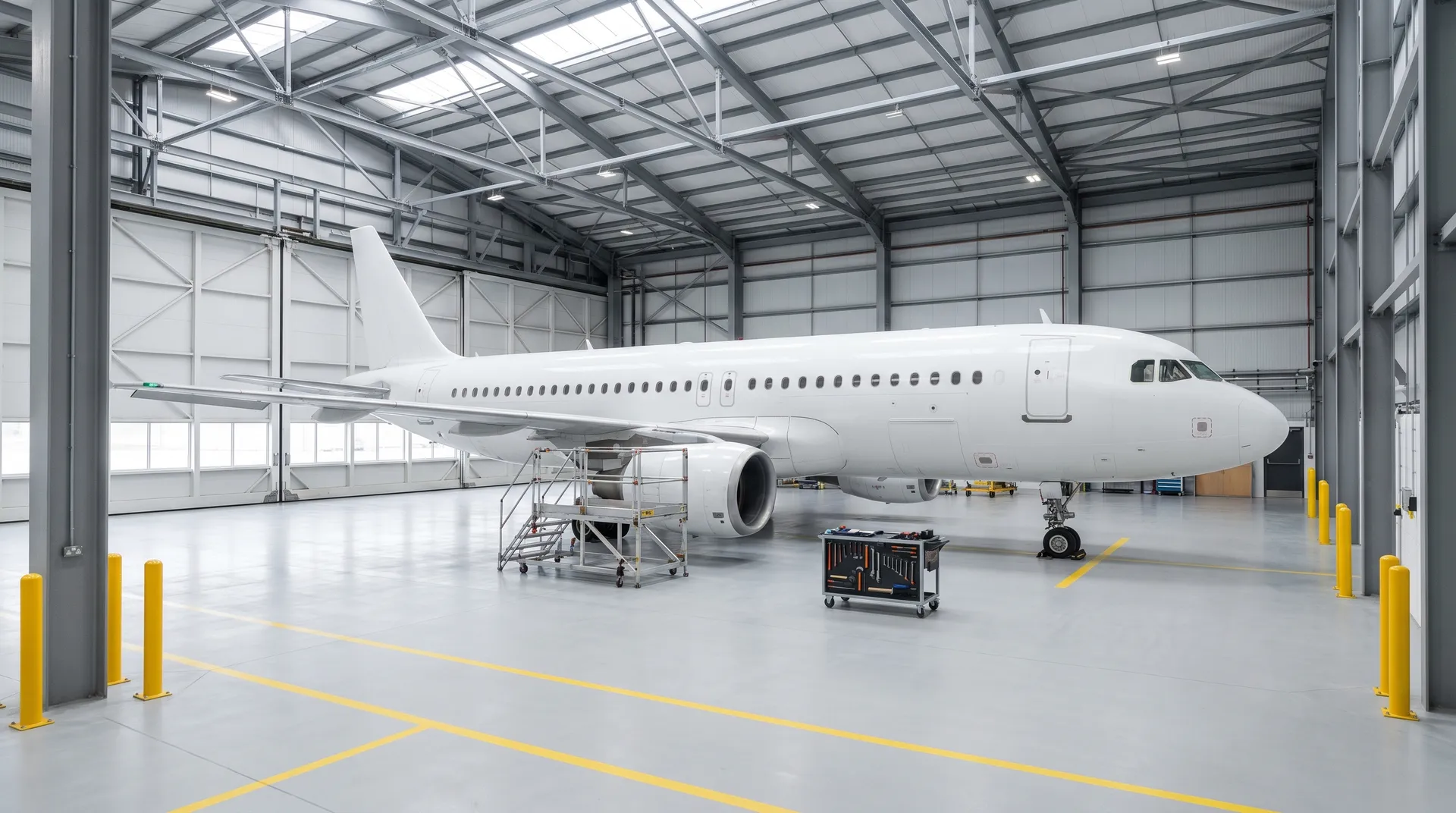
You operate a hangar in Mirabel, Mississauga, Hamilton, or Saint-Hubert. The aircraft inside has hundreds of gallons of Jet A or Avgas in the wings. Fueled aircraft + hangar = classified hazardous zones around the wings and engines, even if the engines are off. NFPA 409 (Standard on Aircraft Hangars) is what governs this, and most general contractors get it wrong on first try. Here's the short version.
What hazard you're dealing with
Aircraft fuel vapors are heavier than air and accumulate near the floor. NFPA 409 (applied through NEC/CEC Article 513) takes the simple approach: the entire hangar floor area, up to 18 inches above the floor, is classified Class I, Division 2, Group D regardless of where the aircraft is parked. A second, separate zone layers on top of that: within 5 ft horizontally of any aircraft power plant or fuel tank, the classified volume extends from the floor up to 5 ft above the upper surface of the wings and engine enclosures. That means the space right around a parked aircraft's engines and wings stays Division 2 well above the 18-inch line. Outside both of those zones, the hangar is unclassified (unless you have fuel pits, vents, or specific service areas with tighter zones). Vapors are present only under abnormal conditions (a fueling spill, a tank vent, a damaged line) but they're still classified.
How the code classifies your hangar
NFPA 409 splits hangars into Groups I-IV by size and use. Group I has door height >28 ft OR fire area >40,000 sq ft. Group II has door ≤28 ft AND area ≤40,000 sq ft. Group III has door ≤28 ft AND area ≤30,000 sq ft. Group IV is membrane-covered rigid steel frame. Most Canadian MRO and corporate hangars are Group II or Group III.
| Where | Classification | What you need |
|---|---|---|
| Hangar floor area, up to 18 in above floor | Class I, Division 2, Group D | Vapor-tight, T4 |
| Within 5 ft horizontally of an aircraft engine or fuel tank, up to 5 ft above the wing/engine top | Class I, Division 2, Group D | Vapor-tight, T4 |
| Pit / trench / fuel-collection sub-floor | Class I, Division 1 or 2 | Explosion-proof |
| Adjacent / communicating areas (parts wash, paint locker) | Class I, Division 2 (often) | Vapor-tight |
| Hangar overhead and walls, outside the 18-in floor blanket and the 5-ft engine/fuel-tank zone | Unclassified | Standard high bay LED |
| Office / admin separate room (cut off from hangar) | Unclassified | Standard commercial LED |
That's the simple version. If your hangar has integrated fueling positions or fuel storage rooms, NFPA 30A layers additional Class I Div 1 zones around fuel pumps and dispensers. Those are tighter zones than the hangar floor blanket. Most Canadian hangars don't fuel inside the hangar, so the 18-inch floor blanket plus the 5-ft engine/fuel-tank zone is the working rule.
The lighting
- Fixture type: High-bay LED (200–400 W LED equiv) in the overhead. Most lighting lives here, in the unclassified zone. Vapor-tight or explosion-proof Class I Div 2 LED for any fixture mounted within 18 inches of the floor, within 5 ft of an aircraft engine or fuel tank, or in pits / fuel-collection areas.
- T-code: Jet A autoignites at 210 °C. The NEC 80% rule for Class I Div 2 caps surface temperature at 80% of AIT: that's 168 °C for Jet A. T3 (max 200 °C) exceeds that ceiling and fails the margin. T4 (max 135 °C) is required.
- IP rating: IP65 minimum for high bay (dust + occasional spray); IP66 for low-mounted classified zones.
- Light level: 300–500 lux on the hangar floor for general MRO work. 750 lux at maintenance bays where detailed inspection happens. 200 lux for parking-only hangars.
- CRI: 80+. Paint and corrosion inspection on aircraft skins benefits from good color rendering.
- CCT: 5000 K daylight matches outdoor inspection conditions.
- Mounting height: Hangars are tall, typically 30–60 ft AGL. Use high-output LED that reaches the floor without glare from below.
Cables & accessories: yes, we supply these too
Most hangar lighting runs in TECK90 or AC90 in unclassified overhead zones, transitioning to TECK90 with sealed glands for the few Class I Div 2 fixtures near aircraft. CSA C22.2 No. 174 glands at every classified-zone penetration; sealing fittings within 18 inches of every classified-area boundary. We supply the fixtures, cable, and glands together. Most hangar contractors are general-trade, not hazloc-specialist, so we ship a layout drawing showing what goes where.
Quebec rule
Quebec hangars are at YUL (Mirabel + Dorval), CYHU (Saint-Hubert, Bombardier), and YQB (Quebec City Jean-Lesage). RBQ inspects under Code de construction chapter V. Bill 96 requires French signage in the workplace, relevant for safety placards and operator-facing labels. Hydro-Québec's Solutions efficaces covers hangar LED retrofits at up to 90% of eligible costs and is well-suited to high-bay overhead conversions where energy savings are dramatic.
Ontario rule
Ontario hangars cluster at YYZ (Toronto Pearson, Air Canada and WestJet MRO), YHM (Hamilton, Cargojet), YOW (Ottawa), and CYTZ (Toronto Island). ESA inspects under the OESC. NFPA 409 is enforced via local fire code. Save On Energy's Retrofit Program covers up to 50% of LED conversion project cost. Hangar high-bay retrofits typically have a 2–3 year payback after the rebate.
Common questions
Is the entire hangar Class I Division 2? The floor of the hangar, yes, up to 18 inches above the floor. NFPA 409 also classifies a second zone: within 5 ft horizontally of any aircraft engine or fuel tank, from the floor up to 5 ft above the wings and engine enclosures. Above both of those zones, the rest of the hangar volume is unclassified. That's why standard high-bay LED works for the overhead well clear of a parked aircraft, and only the low-mounted or near-aircraft fixtures need the Div 2 rating.
What about empty hangars with no aircraft? NFPA 409 applies when fueled aircraft are or could be present. If the hangar is dedicated to unfueled storage (defueled aircraft or aircraft components only), the classification can be removed, but most operators keep the rating since aircraft come and go.
Do I need explosion-proof fixtures over the maintenance bay? Above 18 inches off the floor is unclassified only outside the zone around the aircraft itself. Fixtures within 5 ft horizontally of an aircraft's engine or fuel tank, and up to 5 ft above the wings or engine enclosures, still need the Div 2 rating even though they sit well above 18 inches. Fixtures outside that radius and above 18 inches are unclassified. Confirm the exact fixture layout against your hangar's area-classification drawing.
Vapor-tight vs explosion-proof: which does my hangar need? Vapor-tight is the Division 2 answer: a sealed housing that keeps the atmosphere from reaching an ignition source, and it's what covers the hangar floor blanket and the engine/fuel-tank zone. Explosion-proof (Division 1) fixtures use a heavier cast enclosure built to contain an internal ignition, and in a hangar that's reserved for the tighter Division 1 zones, such as fuel pits, trenches, or fuel-collection sub-floor areas under NFPA 30A. Most hangar ceiling and wall lighting is Division 2 vapor-tight; explosion-proof is the exception for pit and fueling-position areas. Confirm which Division your pit or trench carries against your area-classification drawing.
What if I do hot work in the hangar? NFPA 409 has separate provisions for hot work. The classification doesn't change, but you need ventilation and a fire watch. Lighting spec stays the same.
My hangar has a paint booth in one corner. Different rules? Yes. The paint booth is Class I Division 1 inside (NFPA 33). The booth has its own classification independent of the hangar's NFPA 409 zones. See our Paint Booth Lighting guide.
Related reading
- Hazardous Location Classifications: what Class, Division, Group, and T-code mean on a fixture nameplate.
- Chemical Plant Lighting: how Group D fixture selection works across a wider mix of chemicals.
- Cannabis Extraction Lighting: another Group D application that lands on the same T4 minimum.
Talk to a specialist
Retrofitting an MRO hangar? Send us your hangar dimensions, Group classification (I-IV), and aircraft type. We quote the high-bay overhead and the classified-zone perimeter as one package. Or browse Class I Division 2 vapor-tight LED.
Sources: NFPA 409 (2022 ed.), CEC Section 18, NEC Article 513, RBQ Classification, ESA Bulletin 18-1-21, Hydro-Québec, Save On Energy.
Spec'ing a project? We quote the whole package: fixtures, cable, glands, sealing fittings. Same day.