
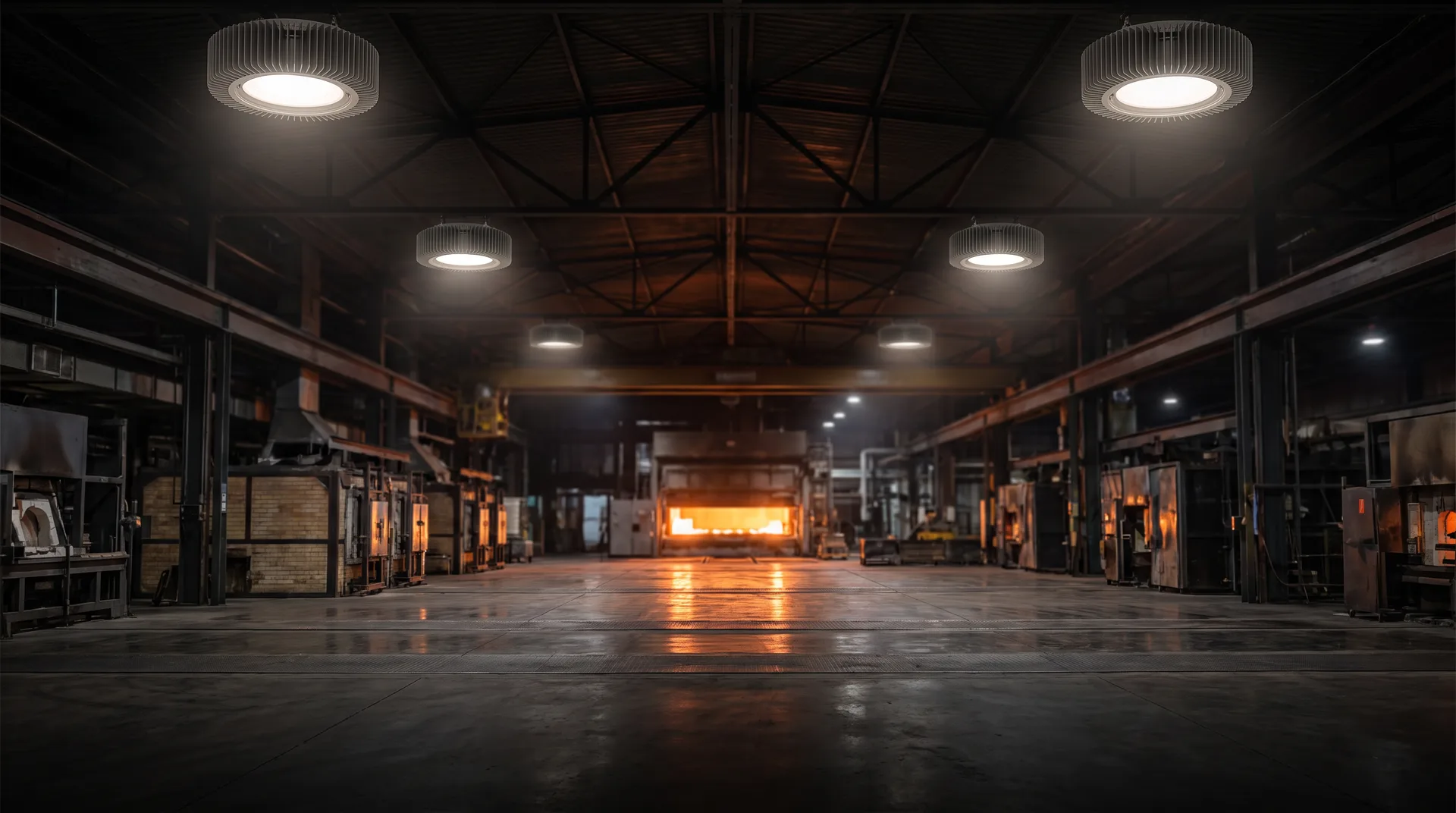
"High temperature" isn't a regulated term, so anyone can put it in a product name. The number that actually matters is the fixture's tested ambient temperature rating, often marked Ta on the nameplate. Some fixtures marketed as "high temperature" are only tested to roughly 60–65°C ambient. Nemaled's High Temperature line carries verified ambient ratings up to 80°C, documented on each fixture's own spec sheet. The gap between a marketing label and a tested number is the difference between a fixture that survives near a furnace and one that fails within a year of installation.
What an ambient temperature rating actually means
The ambient rating is the maximum surrounding air temperature the fixture is tested to run at continuously, not the surface temperature it can briefly touch or a peak it can survive for a few minutes. Testing follows thermal endurance standards used across the lighting industry, broadly aligned with UL 8750 and IEC 60598 thermal test methods. The fixture runs at rated ambient for an extended period while driver and LED junction temperatures are monitored to confirm they stay within the component manufacturers' limits.
That distinction matters because LED drivers and diodes are rated for a maximum junction temperature. Run them hotter than their design allows, even briefly, and both driver lifespan and L70 lumen-maintenance life drop, often well before the fixture's advertised lifespan and well before the warranty period is up.
Why some "high temperature" fixtures fail early
A fixture tested only to 60–65°C ambient, installed in a real 80–100°C environment near a furnace, kiln, or foundry floor, runs its internal components hotter than they were ever validated for. The failure doesn't show up on day one. It shows up as accelerated driver failure and early lumen depreciation months into service, by which point the buyer has already paid for and installed the wrong fixture. The name on the box doesn't protect against this; only the tested number does.
How to verify a real rating before you buy
- Ask for the spec sheet's printed ambient rating: a specific number in °C or °F, not a marketing phrase like "heat resistant" or "industrial grade."
- Ask which standard the rating was tested against: a credible spec sheet references a thermal test method, not just a claimed number.
- Match the rating to your actual measured ambient, not the room's design temperature. Near-furnace and near-kiln zones often run hotter than facility drawings assume, so measure it if you're not sure.
- Treat "high temperature" as a starting point for questions, not a spec: the fixture's actual name tells you the manufacturer's marketing angle, not the number.
What real ratings look like in this category
Ambient ratings genuinely tested above the low-60s°C range exist and are documented on manufacturer spec sheets. That's the band to look for when a zone runs hot: foundries, steel and aluminum plants, kilns, and glass and ceramics manufacturing. Nemaled's High Temperature line, also browsable in the high-temperature high bay category, carries verified ambient ratings up to 80°C, per each fixture's own spec sheet:
| Fixture | Ambient rating | Wattage | Efficacy |
|---|---|---|---|
| HB-D | Up to 80°C (176°F) | 50–400W (modular) | N/A |
| HB-A | Up to 70°C (158°F) | 50–600W | Up to 140 lm/W |
| UFO-I | Up to 80°C | N/A | Up to 150 lm/W |
These are the numbers printed on each fixture's spec sheet, not a blanket category claim. Always confirm the specific model's rating rather than assuming every fixture in a "high temperature" line shares the same number.
If your zone runs hotter than 80°C ambient
Some zones, such as the area immediately around a melt-pour operation or a kiln crown, run hotter than 80°C ambient. That's above what a standard catalog fixture in this line is validated for. A zone like that typically needs an engineered solution: a remote-mounted driver moved out of the high-heat area, or a custom thermal design built around the specific measured temperature. Send us your measured ambient for that mounting location and we'll tell you what's realistic for it, rather than assuming a general "high temperature" fixture covers it.
Matching a fixture to your zone
Ambient heat isn't uniform across a plant. A foundry's general floor typically runs cooler than the zone immediately around a melt-pour operation. Spec the fixture to your actual measured or documented ambient at the mounting location, not the hottest point in the building and not the coolest, and confirm the printed rating covers it with a reasonable margin rather than right at the edge. The same logic applies whether you're specifying foundry lighting over a casting bay or steel mill lighting along a rolling line: the ambient at the mounting point decides the spec.
Common questions
Is a higher ambient rating always better? Not necessarily worth paying for if your zone doesn't need it. Fixtures built for higher ambient ratings are typically more heavily engineered (larger heat sinks, different driver placement) and cost more. Spec to your actual measured ambient plus a reasonable margin, not the highest number available.
Does a high ambient rating mean the fixture is also hazardous-location certified? No. Ambient temperature rating and hazardous-location certification (Class I/II, Division 1/2) are two separate specs tested against different standards. A high-ambient industrial fixture is not automatically explosion-proof or dust-ignition-proof. Check both ratings independently if your zone is also gas- or dust-classified.
Is an ambient rating the same as a hazloc T-code? No. An ambient temperature rating (Ta) describes the surrounding air temperature a fixture is tested to run in continuously. A hazloc T-code (such as T3 or T4) describes the maximum surface temperature the fixture itself can reach, so it doesn't become an ignition source for a specific gas or dust in a classified area. The two are tested against different standards and answer different questions, so check both separately if your zone is both hot and hazardous-classified.
Can I run a standard-rated LED high bay near a furnace if I add extra ventilation? Ventilation can help, but it doesn't change the fixture's tested rating or its driver's validated limits. If the documented ambient at the mounting location exceeds the fixture's tested rating, the safer and more reliable path is a fixture rated for that ambient, not a workaround.
Where do I find the tested ambient rating on a spec sheet? Look for a line labeled "ambient temperature," "operating temperature range," or "Ta," usually near the electrical specifications. If a listing doesn't show this number at all, ask for it directly before buying.
What happens if a fixture runs hotter than its rated ambient? The driver and LEDs run past the temperature they were validated for. That typically shortens driver lifespan and speeds up lumen depreciation, so the fixture reaches the end of its useful life well before its rated lifespan, even though it may keep running for a while first.
Sources: UL 8750 (Standard for LED Equipment for Use in Lighting Products), IEC 60598 (Luminaires, thermal test methods), UL 1598 / CSA C22.2 No. 250.0 (Luminaires, the general luminaire safety standard referenced alongside ambient-rating testing), manufacturer spec sheets referenced above.
Besoin d'un luminaire spécifié à votre environnement ? Envoyez les dimensions de la pièce, la classification et la température ambiante, nous vous répondons le jour même.
Demander une soumission