
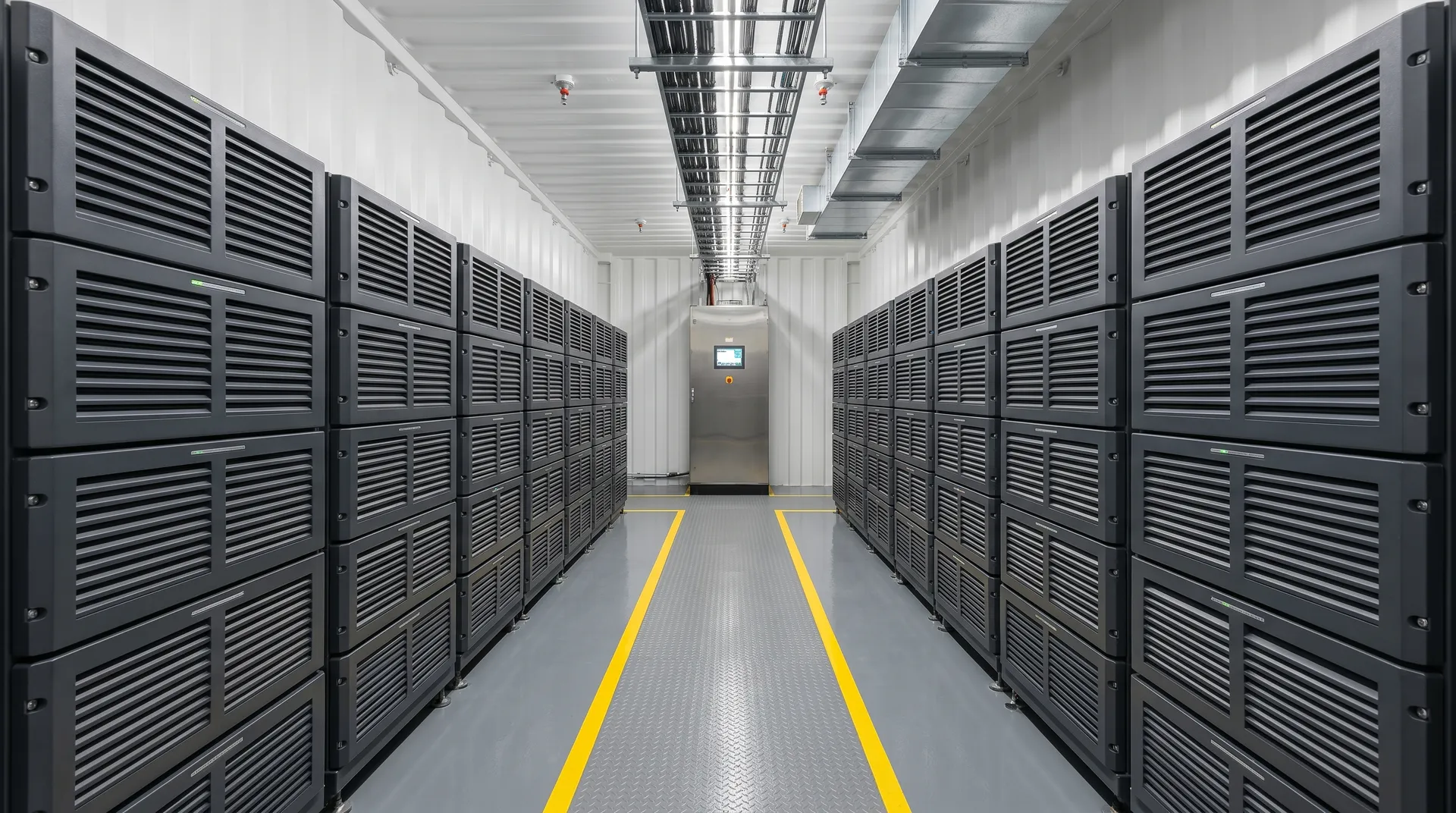
You manage a battery room: telco, hospital UPS, data center backup, hydroelectric station. Vented lead-acid (VLA) and flooded cells off-gas hydrogen during charge. If room ventilation fails, hydrogen accumulates and the room becomes Class I, Division 2, Group B. Standard fluorescent fixtures? Code violation. Here's what actually meets RBQ and ESA expectations.
What hazard you're dealing with
Hydrogen is sneaky. It's lighter than air, odorless, invisible, and ignites with as little as 0.02 mJ of energy, about 1/100th of a static spark from your hand. Vented lead-acid batteries during charging release H₂ at predictable rates; AGM and VRLA cells release much less but aren't zero. The code allows you to declassify a battery room if ventilation guarantees H₂ stays below 1% of room volume, but only if the ventilation is verified, monitored, and interlocked. Otherwise you're in Class I Div 2 territory.
How the code classifies your battery room
| Battery type | Ventilation status | Classification | What you need |
|---|---|---|---|
| VRLA/AGM (sealed), small bank | Adequate (≥6 air changes/hr) | Unclassified | Standard industrial LED |
| VLA / flooded, with ventilation interlock | H₂ <1% verified | Unclassified per NEC 480 | Standard LED, IP54+ |
| VLA / flooded, ventilation only | Not interlocked | Class I, Division 2, Group B | Vapor-tight or Ex-proof Group B |
| Any battery, no ventilation or unverified | Unverified | Class I, Division 2, Group B | Vapor-tight Group B, T2 minimum |
| Direct ceiling above flooded cells | H₂ accumulates here | Class I Division 2 within 18" of ceiling | Group B fixture |
NEC 480 (Storage Batteries) is the authoritative reference. CEC Section 18 enforces equivalent rules in Canada.
The lighting
- Fixture type: If the room is classified: vapor-tight or explosion-proof LED with Group B rating (hydrogen). If declassified by ventilation: standard industrial LED IP54+ is fine.
- T-code: Hydrogen autoignites at 500 °C. The 80% margin rule caps allowable surface temperature at 400 °C, so T1 (450 °C max) does not clear that margin, even though it's the T-code most often associated with hydrogen on a generic chart. T2 (300 °C) is the practical minimum that stays under the 400 °C ceiling. Most LED fixtures easily hit T3-T4 well below either threshold, but the housing must still carry the Group B rating.
- IP rating: IP54 minimum (battery rooms can have acid mist). IP65+ if floors are pressure-washed.
- Light level: 200 lux for inspection and maintenance. 300 lux at battery monitor displays. Avoid harsh light directly on cells (operators read electrolyte levels through translucent cases).
- CRI: 70+ is fine.
- CCT: 4000 K, easier on operator eyes during long inspection rounds.
- Mounting: Pendant or surface, away from acid spray paths. Don't recess fixtures above battery rows.
Data center and UPS battery rooms
Data center and UPS battery rooms increasingly run sealed VRLA or lithium-ion strings instead of flooded lead-acid, partly because unattended, densely packed rooms make hydrogen ventilation harder to guarantee at scale. If a data center or UPS plant still runs VLA or flooded cells (common in older telco central offices and legacy UPS rooms), treat it like any other Division 2 candidate: verify the ventilation interlock is actually monitored, not just installed, and default to Group B-rated fixtures unless your design engineer has documented H₂ staying below 1% by volume. Lithium-ion battery rooms are a separate hazard profile (thermal runaway, not hydrogen off-gas) and aren't Class I Division 2 by default; see the FAQ below.
Cables & accessories: yes, we supply these too
If the room is classified Class I Div 2, run TECK90 with CSA C22.2 No. 174 glands rated for Group B (most hazloc glands cover all gas Groups but verify nameplate). Sealing fittings within 18 inches of any classified-area penetration. JBs must be Group B-listed if installed in the classified zone. Standard NEMA 12 enclosures are fine for unclassified rooms with proper ventilation. We supply the ventilation interlock relay too. Many smaller installs skip it and end up classified by default.
Quebec rule
Quebec hospital UPS rooms (CHUM, MUHC, Sainte-Justine), telco central offices (Bell, Telus), and Hydro-Québec dam control rooms all need this spec. RBQ inspects under Code de construction chapter V. Bill 96 safety labeling applies. Hydro-Québec's Solutions efficaces covers LED retrofits in commercial / institutional battery rooms. Typical retrofit pays back in 18–24 months given long burn hours.
Ontario rule
Ontario hospital + data center clusters (Mississauga, Toronto, Markham) and Hydro One substation battery rooms are inspected by ESA under the OESC. ESA Bulletin 18-1-21 covers classification practice. Save On Energy's Retrofit Program covers up to 50% of project cost.
Common questions
My room has VRLA sealed cells. Do I still need Group B fixtures? If H₂ generation is verified low and ventilation maintains <1% by volume, NEC 480.10 lets you declassify. Most modern VRLA installs do declassify. But verify with your design engineer: some AHJs are conservative and require Group B regardless.
What's "6 air changes per hour" mean in practice? Total room volume divided by ventilation flow rate. A 1,000 ft³ battery room needs 100 ft³/min of forced exhaust to hit 6 ACH. Most code-compliant battery rooms have continuous mechanical ventilation that achieves this easily.
Group B vs Group D fixtures: what's the difference? Group B covers hydrogen, ethylene oxide, and butadiene, gases with a much lower minimum ignition energy than the Group D solvents and hydrocarbons found in most industrial hazloc specs. A Group B-rated fixture is also approved for Group C and D atmospheres (it's the stricter rating), but a Group D fixture is not approved where hydrogen is present. Battery rooms with vented lead-acid or flooded cells specifically need a Group B nameplate; confirm it before ordering.
Do I need a hydrogen detector? Recommended, not always required. NFPA 70 doesn't mandate H₂ detection; some local codes do. A continuous H₂ monitor with alarm at 1% LEL is good practice and supports declassification.
Are battery rooms a YMYL site for SEO? (SEO trivia: yes, hospital and telco backup is YMYL "Your Money or Your Life" content. We cite primary sources and have author credentials on our resource articles for E-E-A-T.)
What about lithium-ion battery rooms? Different hazard entirely: thermal runaway, not H₂ off-gas. NFPA 855 covers Li-ion ESS installations. Not Class I Div 2 by default. Different fixture spec.
Related reading
- Hazardous Location Classifications: what Class, Division, Group, and T-code mean on a fixture nameplate.
- Chemical Plant Lighting: how Group B hydrogen-rated fixtures get chosen in a facility handling several chemical groups at once.
Talk to a specialist
Spec'ing a battery room? Tell us battery type, count, and ventilation status. We quote the lighting, interlock, cable, and glands as one package. Or browse Class I Division 2 vapor-tight LED.
Sources: NEC Article 480, NFPA 70, CEC Section 18, RBQ Classification, ESA Bulletin 18-1-21, Hydro-Québec, Save On Energy, Eagle Eye Power Solutions.
Spécifier un projet ? Nous soumissionnons le lot complet : luminaires, câbles, presse-étoupes, raccords d'étanchéité. Le jour même.