

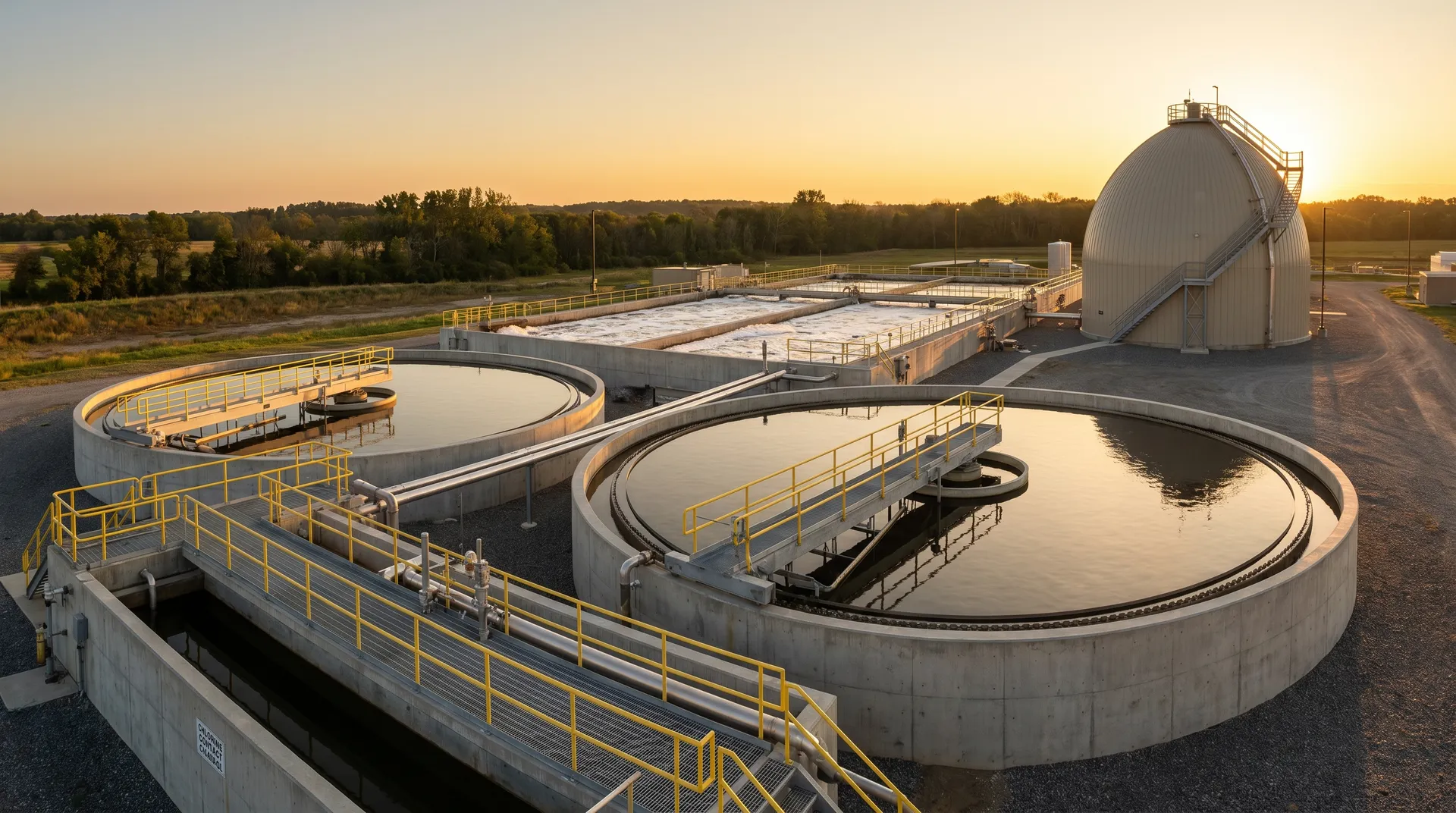
Your treatment plant has two enemies: corrosive chemicals and operating moisture. Chlorine vapor eats steel from the inside out. Methane builds up in primary clarifier buildings. Ozone strips sealants. Pick the wrong fixture and you'll be replacing it inside 18 months. Here's what survives a Canadian municipal plant and what doesn't.
What hazard you're dealing with
Two distinct problems in the same building. First, corrosion: chlorine, sulfuric acid, sodium hypochlorite, and ferric chloride vapors degrade aluminum, steel, and most plastics. Second, methane: anaerobic digesters, sludge processing, and primary clarifiers generate methane that pockets in headspace. That makes parts of the plant Class I, Division 2 even though the rest is just "industrial wet."
How the code classifies your plant
| Where | Classification | What you need |
|---|---|---|
| Enclosed or poorly ventilated areas with exposed wastewater (covered channels, enclosed screen rooms, primary clarifier interior, sludge dewatering with open access) | Class I, Division 1, Group D | Explosion-proof LED, T3 |
| Well-ventilated open areas with exposed wastewater (open-air channels, outdoor screening), per your plant's NFPA 820 evaluation | Class I, Division 2, or unclassified, Group D | Vapor-tight LED, T3 (standard LED if the study clears it) |
| Areas conveying / metering / pumping wastewater in enclosed pipes | Class I, Division 2, Group D | Vapor-tight LED, T3 |
| Anaerobic digester building (with sealed digester) | Class I, Division 2 (typically) | Vapor-tight LED, T3 |
| Chlorine room, hypochlorite storage | Unclassified but corrosive | NEMA 4X stainless or FRP |
| Outdoor process areas (general) | Outdoor wet, NEMA 4X | Marine-grade LED area light |
| Headworks / screening / outdoor channels | Class I Div 1 or Div 2 + corrosion, per ventilation | Explosion-proof or vapor-tight stainless / FRP |
NFPA 820 (Standard for Fire Protection in Wastewater Treatment and Collection Facilities) is the authoritative reference. The starting rule: exposed wastewater in an enclosed or poorly ventilated space is Class I, Division 1; enclosed-pipe processes are Division 2. NFPA 820 lets continuous, adequate ventilation downgrade an area a level (Division 1 to Division 2, or Division 2 to unclassified), so a well-ventilated open channel or screen room is often Division 2 or unclassified rather than a blanket Division 1. That call comes out of your plant's own NFPA 820 ventilation evaluation, not a one-size rule. CEC Section 18 enforces both in Canada.
Wastewater Treatment Plant Lighting by Process Area
Matching the right fixture to each process area is most of the spec work on a wastewater treatment plant lighting project. Classified wet areas (open channels, clarifiers, digester buildings) need Division-rated explosion-proof or vapor-tight LED per the table above. Corrosive but unclassified areas (chlorine rooms, chemical storage) need NEMA 4X stainless or FRP regardless of Division. Outdoor yard and walkway lighting needs both a weather rating and, near any classified boundary, the matching Division rating. Pull the process-area list from your plant's NFPA 820 study and we'll match a fixture family to each line.
Digester Building Lighting
Anaerobic digester buildings run on the same methane hazard logic as an oil & gas site: a sealed digester vents methane into the building headspace, which is why the space is typically Class I, Division 2. If your plant also runs a co-located biogas-to-energy setup or landfill-gas tie-in, our Oil & Gas Site Lighting guide covers the same Group D, methane-driven classification from the gas-handling side.
The lighting
- Fixture type: Stainless steel or fiberglass-reinforced polyester (FRP) housing (never powder-coated steel) for chlorine zones. Vapor-tight LED linear or area light.
- T-code: T3 minimum where methane is possible (auto-ignition ≈537 °C; T3 max 200 °C is well below).
- IP rating: IP66 minimum. IP67 if hose-down is regular practice. Avoid IP65-only fixtures.
- NEMA rating: NEMA 4X is the keyword. It adds a 600-hour salt-spray corrosion test (measured against Type 304 stainless pitting) on top of IP66 water protection.
- Light level: 100–200 lux walkways and process floors; 500 lux at instrument panels and lab benches.
- CRI: 70+ general; 80+ in lab and analytical areas.
- CCT: 4000–5000 K.
- Lens material: Polycarbonate, not glass. Glass cracks under thermal shock during chemical wash.
Cables & accessories: we supply these too
In Class I Div 2 methane zones, TECK90 with sealed glands. In corrosive non-classified zones, stainless cable trays with PVC-jacketed ACWU or AC90 cable. CSA C22.2 No. 174 glands rated for the chemical environment (some need Hastelloy or 316 stainless). FRP junction boxes for chlorine rooms, never aluminum. We ship the whole package so your contractor doesn't mismatch a 304SS gland into a chlorine zone (304 will pit in 6 months; 316 or FRP is the right call).
Quebec rule
Quebec municipal plants are inspected by RBQ under Code de construction chapter V. The Ministry of Environment (MELCCFP) has its own design guidelines that often exceed CEC Section 18. Bill 96 requires French safety labels, relevant for instrument-room and chlorine-room signage. Hydro-Québec's Solutions efficaces funds LED conversions at municipal facilities up to 90% of eligible costs.
Ontario rule
Ontario plants are inspected by ESA under the OESC. The Ontario Clean Water Agency (OCWA) operates many plants on behalf of municipalities and has standardized lighting specs. Save On Energy's Retrofit Program covers up to 50% of project costs, and Ontario Power Generation has additional incentives for water-utility customers.
Common questions
Is NEMA 4X automatically Class I Division 2 rated? No. NEMA 4X is a corrosion + water rating. Class I Div 2 is a hazardous-area rating. They're separate. A fixture can be one without the other. For digester buildings you need both.
Do I need explosion-proof lighting in a chlorine room? Usually no. Chlorine isn't flammable; it's corrosive and toxic. The chlorine room is unclassified for explosion but needs aggressive corrosion protection (NEMA 4X stainless or FRP).
What about H2S at the headworks? Hydrogen sulfide shows up at headworks and other points where wastewater agitates or sits under septic conditions. It's toxic at low concentrations, corrosive to steel and concrete, and also flammable with a fairly low autoignition point, so it factors into the area's Class I classification alongside methane. Continuous gas detection is standard practice at headworks. Confirm the exact classification and any H2S-specific T-code requirement against your plant's NFPA 820 study.
What about UV disinfection chambers? UV chambers themselves don't typically need hazardous lighting; they need UV-resistant lens material and corrosion-resistant housings. Ozone-based disinfection is more aggressive on materials.
My plant has a small Class I Div 2 zone. Can I use Class I Div 1 fixtures throughout? Yes. Div 1 fixtures are always acceptable in Div 2 areas. It's overkill but legal and simplifies inventory.
How long do LED fixtures last in a wastewater environment? With NEMA 4X stainless or FRP body and IP66 sealing, expect 50,000+ hours (5–7 years). Painted-steel fixtures typically fail at 12–24 months due to corrosion at the housing seams.
Talk to a specialist
Designing a plant retrofit or new build? Send us your process areas and classification, and we quote fixtures, cable, FRP/stainless glands, and corrosion-resistant junction boxes as one package. Or browse NEMA 4X vapor-tight LED for corrosive non-classified zones, or Class I Division 2 vapor-tight LED for the classified wet areas.
Sources: NFPA 820, CEC Section 18, RBQ Classification, ESA Bulletin 18-1-21, Hydro-Québec, Save On Energy, Holophane wastewater white paper.
Spec'ing a project? We quote the whole package: fixtures, cable, glands, sealing fittings. Same day.