

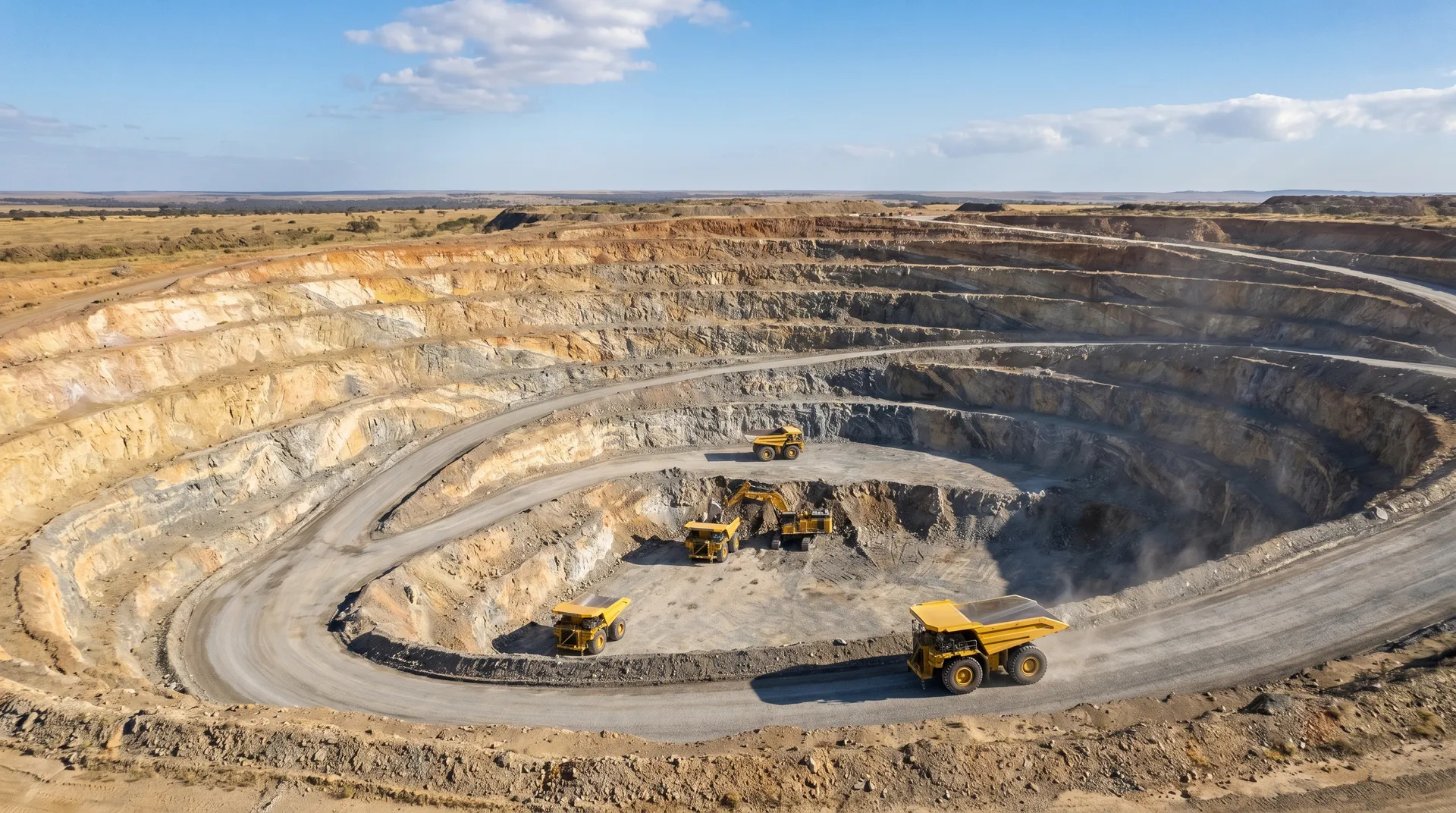
Canadian mining covers a wide range: Sudbury nickel, Val-d'Or gold, Témiscamingue copper, Saskatchewan potash, Alberta oil sands. Each has different hazard mixes (methane in coal, dust in potash, hydrocarbon vapors in oil sands processing). Lighting spec depends on whether you're surface or underground, and on the specific commodity. Here's the practical breakdown.
What hazard you're dealing with
Underground coal mining: methane in workings means Class I, Division 1, Group D, plus coal dust means Class II, Group F. Underground hard rock (gold, nickel, base metals): typically dust, diesel exhaust, and occasional methane in deep mines. Surface mining: dust from pit operations plus diesel-handling areas (refueling, maintenance shops). Mineral processing plants: classification depends on commodity; potash dust is Class II, gold cyanide circuits are unclassified but corrosive, and oil sands extraction has Group D vapors.
How the code classifies typical mining zones
| Where | Classification | What you need |
|---|---|---|
| Underground coal (working face, return air) | Class I, Div 1, Group D + Class II | MSHA + UL listed, T2 |
| Underground hard rock (main drift, working face) | Usually unclassified (or Class II if dusty) | Heavy-duty industrial LED |
| Refuel station / fuel storage (any mine) | Class I, Division 1 or 2, Group D | Explosion-proof, T3 |
| Maintenance shop with welding | Class I, Division 2 (within 3 ft of fuel) | Vapor-tight |
| Crusher / mill / dry processing | Class II, Division 1 or 2 | Dust-ignition-proof or dust-tight |
| Concentrator (wet processing) | Wet, NEMA 4X corrosion | Stainless or FRP LED |
| Headframe + hoist room | Industrial wet | Heavy-duty LED |
| Surface offices + admin | Unclassified | Standard commercial LED |
In Canada, mine electrical work falls under CSA M421 (mining electrical) on top of CEC Section 18. Ontario's Mining Act + Mines and Aggregates Safety and Health Association (MASHA) have additional guidance. Facilities with Class II dust hazards (potash, coal, crusher/mill dry processing) follow the same dust-ignition-proof logic as grain handling; see our Grain Elevator & Silo Lighting guide for the T-code selection method.
The lighting
- Fixture type: Heavy-duty industrial LED with impact-resistant lens (rocks fall in mines). Hazardous-area variants where classified. Cold-start performance for surface mines in Northern Quebec / Ontario.
- T-code: T2 (300 °C max surface) is the baseline used for coal methane zones. Methane's autoignition temperature is commonly tabulated at approximately 537 °C in classification references, with some experimental studies reporting 580-630 °C, so T2 already carries a wide margin below either figure. T3 (200 °C) or T4 (135 °C) add further margin and show up where MSHA/CSA-permissible equipment specs call for it; T3 is the standard elsewhere in the mine.
- IP rating: IP66 minimum throughout. IP67 in concentrator wet circuits.
- Impact rating: IK10 for underground (high impact). IK08 for surface industrial.
- Light level: 50–100 lux underground travelways; 200 lux at working faces; 300+ lux at processing equipment; 500 lux at hoist controls.
- CRI: 70+ underground; 80+ at processing where ore-grade visual is part of the work.
- CCT: 5000 K underground (operators want maximum visibility); 4000 K processing buildings.
- Connection: Cable-entry compatible with mine cable types (often Type SHD-GC for portable, TECK90 for fixed).
Cables & accessories (yes, we supply these too)
Mine fixed installations use TECK90 in raceway or surface-mounted cable tray. Hazardous zones use TECK90-HL with sealed glands. Portable fixtures (face lighting, jumbo lights) use Type SHD-GC mining cable. CSA C22.2 No. 174 glands at every classified penetration. We supply the cable, glands, and impact-resistant junction boxes alongside the fixtures. Mine purchasing departments often source separately and end up with mismatched ratings.
Quebec rule
Quebec mining (Val-d'Or gold, Sept-Îles iron, Schefferville iron) is regulated by CNESST (Commission des normes, de l'équité, de la santé et de la sécurité du travail) for safety, and RBQ for electrical installations on surface infrastructure. The Loi sur les mines + Quebec Mining Industry Code apply underground. Bill 96 mandates French signage in workplaces, relevant for operator-facing labels and safety placards. Hydro-Québec's Solutions efficaces program's Medium and Large Business component covers mineral processing facility LED retrofits up to 75% of eligible costs (program terms as of September 2026).
Ontario rule
Ontario mining (Sudbury nickel, Timmins gold, Red Lake) is regulated under the Occupational Health and Safety Act, Regulation 854 (Mines and Mining Plants). ESA inspects surface electrical; underground inspections involve the Ministry of Labour. MASHA provides industry guidance. Save On Energy's Retrofit Program covers surface mining facility LED retrofits; underground is typically funded through operator capital programs.
Common questions
Are MSHA fixtures legal in Canada? MSHA-listed fixtures are not automatically Canadian-approved. They need CSA or equivalent third-party listing for use in Canadian mines. Many mining-specific fixtures carry both MSHA and CSA listings; verify the nameplate.
MSHA permissible vs CSA-certified: what's the difference? The two aren't interchangeable. MSHA-permissible equipment is formally approved for use in the potentially methane-rich areas of an underground coal mine, evaluated against a stricter fault-tolerance standard meant to hold even with two independent circuit faults. CSA certification for Class I Division 2 covers explosive gas atmospheres more broadly but doesn't carry that coal-mine-specific approval, and generally isn't accepted for the methane-exposed areas of an underground coal mine. Some fixtures carry both listings; check the nameplate rather than assuming one substitutes for the other, and confirm with your mine's ventilation/electrical engineer for the specific zone.
Underground hard-rock mines: do I need explosion-proof lighting? Usually no. Hard-rock mines (gold, nickel, base metals) typically don't have methane unless the geology indicates it. Heavy-duty industrial LED with high impact rating is the standard. Always verify with the mine ventilation engineer.
What about diesel exhaust as a hazard? Diesel particulate is a health concern (DPM), not an explosion hazard. It doesn't trigger Class I/II classification but does drive ventilation requirements. Standard heavy-duty LED is fine.
Mining cable types: TECK90 or SHD-GC? TECK90 for fixed installations (substations, fixed area lights, conveyor lines). SHD-GC for trailing cables on portable equipment (jumbos, scoops, drills). They're different; don't substitute.
Are LED retrofits worthwhile in Canadian mines? Yes. Mines run lighting 24/7 at huge connected loads. A 400 W metal halide replaced with 150 W LED, multiplied by 200 fixtures, saves enormous energy. Plus reduced maintenance trips into hazardous areas.
Talk to a specialist
Mining facility retrofit or new build? Send us the operations details (commodity, surface/underground, processing type) and we quote fixtures + TECK90 + glands + JBs as one package, with MSHA + CSA verification. Or browse heavy-duty industrial LED.
Sources: CEC Section 18, CSA M421, OHSA Regulation 854, CNESST mining rules, NFPA 497 (autoignition temperature tables), RBQ Classification, ESA, Hydro-Québec, Save On Energy.
Spec'ing a project? We quote the whole package: fixtures, cable, glands, sealing fittings. Same day.